Ellis
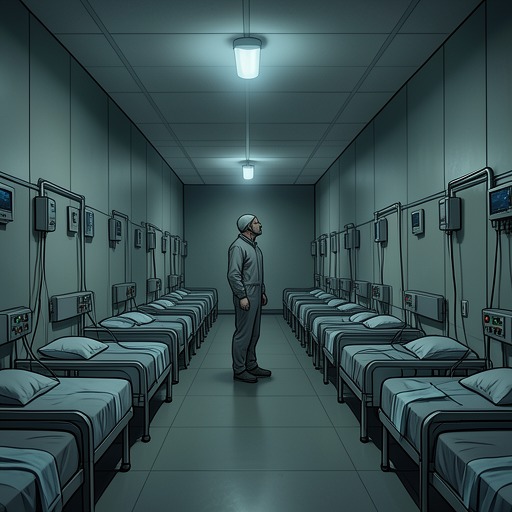
One Flew Over the Cuckoo's NestEllis is a Chronic patient whose body bears the consequences of a treatment that was supposed to repair him. Once an Acute, he is overloaded in the Shock Shop and left immobilized, arms extended and palms cupped, his face fixed in an expression of horror. The ward keeps him standing against a wall like a mounted trophy; his posture makes institutional damage visible as part of the room’s daily furniture.
Identity and Treatment
Ellis entered the hospital as an Acute, but the staff’s mistake during treatment changed his status. The account identifies the Shock Shop as the place where he was overloaded, and presents his resulting condition not as the resolution of illness but as a profound loss of bodily agency. He remains a Chronic, one of the patients the ward regards as beyond repair.
His position is maintained literally. Nails hold his hands against the wall, and The ward's black aides remove them when he must be taken to eat or to bed. Once moved, he leaves a puddle where he stood, which Chief Bromden has to mop. At the previous institution, Ellis stood in one place so long that his urine ate through the floor and beams; he eventually fell through into the ward below, creating difficulties during the census count. The grotesque bureaucratic consequence sits beside the physical one: even his collapse becomes a problem of accounting.
Life in the Ward
Ellis’s posture and placement recur as part of the ward’s daily order. At 7:30, after the patients return to the day room, Nurse Ratched watches through polished glass and starts the routine with a button. The Acutes wait for games, the Chronics for puzzles, and Ellis is assigned to the wall, hands raised for the nails, urine running down his leg. The schedule turns his captivity into a prescribed task, repeated alongside the ward’s other routines.
Chief Bromden’s account describes the patients as figures in a mechanically controlled, cartoon-like world, but Ellis’s condition gives that image an especially concrete form. His body is not simply compared to a machine: the ward arranges and handles it as an object, moving him when required and returning him to the same fixed place. The recurring image of the nails makes visible how institutional routine sustains the condition it claims merely to manage.
Recognition by Randle Patrick McMurphy
When Randle Patrick McMurphy makes his way through the Chronic patients, he shakes Ellis’s hand as if Ellis were an ordinary person whose vote and greeting matter. McMurphy addresses him directly and points out that he is standing in his own urine, then invites him to get dry. The gesture briefly treats Ellis as a participant in a social exchange rather than as part of the ward’s equipment.
Ellis looks down at the puddle in surprise, thanks McMurphy, and takes a few steps toward the latrine. The movement is small but consequential: for a moment he responds to another person and begins to act on what he has been told. Then the nails pull his hands back to the wall. The scene does not suggest that he has recovered; instead, its abrupt reversal shows the limit imposed on even this brief attempt at movement. McMurphy’s greeting acknowledges Ellis, while the ward’s fastening system immediately reasserts control.
Electroshock as Injury and Warning
Ellis also serves as a visible example in the patients’ discussion of electroshock. Dale Harding explains that the treatment can function both as a response to behavior judged hostile and as a punishment, and warns that repeated treatments can leave a man like Ellis. His condition therefore gives the conversation’s description of the Shock Shop a human consequence within the ward: the threat is not abstract when Ellis stands nearby, immobilized and unable to leave his place.
The novel presents Ellis through the severe physical effects of treatment and through the ward’s handling of his body, while allowing only a brief moment of speech and movement. That narrow portrayal makes him an emblem of institutional damage, but it also supplies specific evidence of a lived condition: the surprise of seeing his own puddle, his attempt to walk toward the latrine, and the nails that stop him. His place in the story is consequently both symbolic and material. Ellis shows what the ward’s promised repair can become, and how a system can turn a patient’s impaired agency into a fixed part of its everyday order.